In this article
- The Simple Definition
- How to Measure an Outlier
- Step 1: Find the channel's typical views
- Step 2: Compare the video to that typical number
- Step 3: Read the result
- A quick example (illustrative only)
- Why Outliers Matter
- Outlier vs Viral vs Evergreen Hit
- Types of Outliers (and Why Type Matters)
- 1. The topic outlier
- 2. The packaging outlier
- 3. The timing outlier
- 4. The search outlier
- 5. The external-traffic outlier
- 6. The luck outlier
- What an Outlier Does Not Prove
- How Beginners Can Spot Outliers (Preview)
- Mini Glossary
- Common Mistakes to Avoid
- Frequently Asked Questions
- What counts as an outlier video?
- Can a small channel's outlier help me more than a big channel's?
- How many outliers should I find before choosing a niche?
- Do I need paid tools to find outliers?
- Can I make my own outlier on purpose?
- Is it okay to study other creators' videos this way?
- Final Thoughts
If you've spent any time reading about YouTube strategy, you've probably seen the word outlier. Creators talk about finding outlier videos, studying outlier videos and building ideas around them. But the term often gets used loosely, and beginners are left wondering what it actually means and why anyone cares.
This guide gives you a clear, practical definition, shows you how to measure an outlier with simple math, explains why outliers are useful for finding niche and video ideas, and warns you about the common ways people misread them.
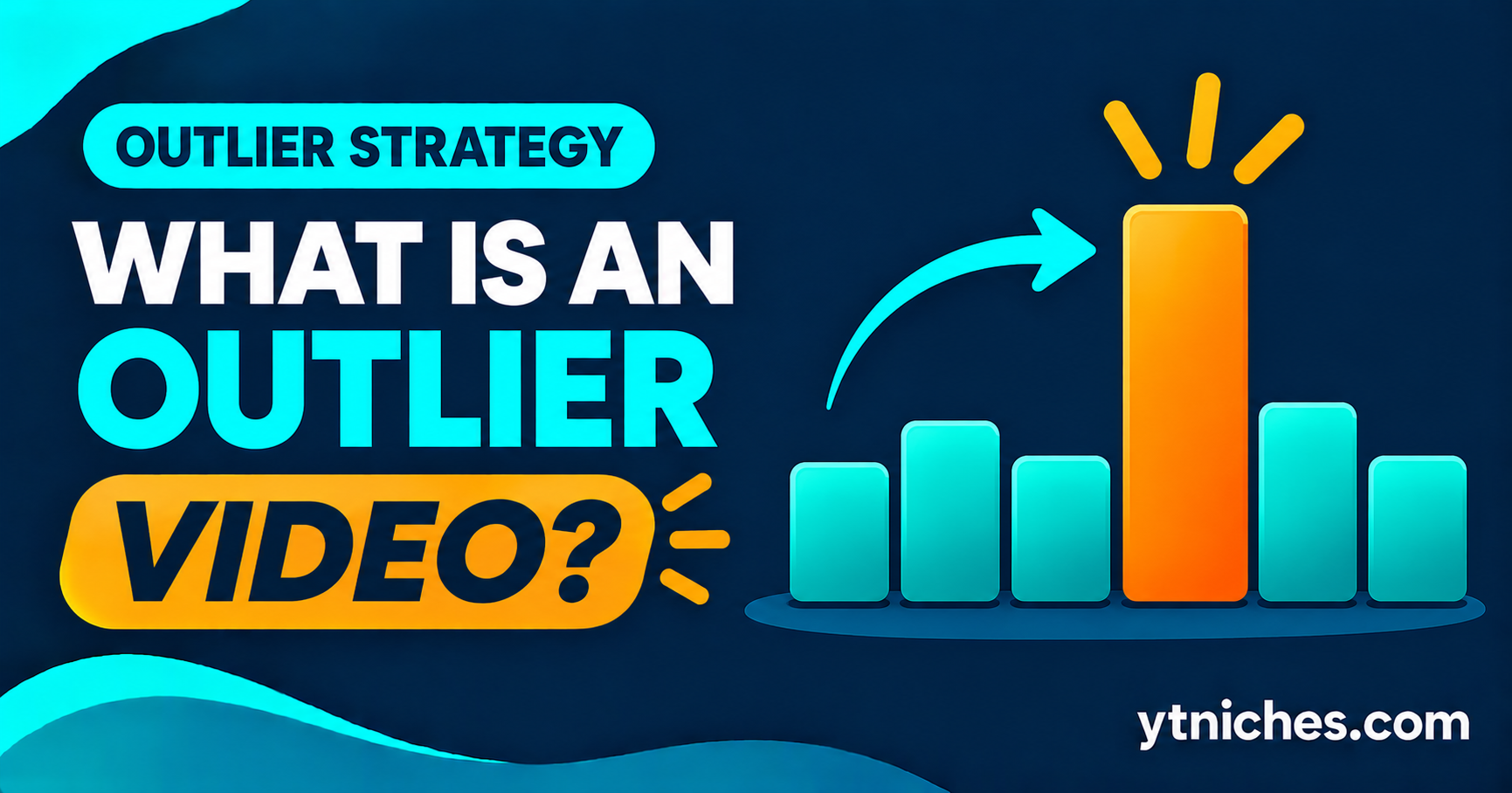
Quick answer: An outlier video is a video that gets far more views than is typical for its channel. If a channel's videos usually get around a certain number of views and one video gets several times that, the high performer is an outlier. Outliers matter because they suggest that the topic, title or packaging resonated with viewers, not just the channel's existing audience.
Author's note: From my experience, an outlier video is simply a video that performs much better than a channel's usual content. For example, if a channel normally gets 1,000 views per video but one video suddenly reaches 50,000 views, that's an outlier. I use these videos to understand what makes people click and watch. It could be the topic, title, thumbnail, or storytelling style. My advice is to regularly study outlier videos in your niche because they can help you discover new content ideas and understand what your audience really wants.
The Simple Definition
The word comes from statistics. An outlier is a data point that sits far from the rest of the group. On YouTube, the "group" is a channel's typical performance, and the data point is one video's views.
Outlier video = a video whose views are far above what that channel normally gets.
The key idea is that it's relative. A video with 50,000 views might be a huge outlier for a channel whose videos normally get 2,000 views, and totally ordinary for a channel whose videos normally get 500,000. What makes it an outlier is the comparison, not the raw number.
How to Measure an Outlier
You don't need special software to understand the math. Use this simple method.
Step 1: Find the channel's typical views
Look at the channel's recent videos (for example, the last 10 to 20 regular uploads, excluding the outlier itself) and estimate a typical number. The median (the middle value when you sort them) is usually better than the average, because one big hit can distort an average.
Step 2: Compare the video to that typical number
Outlier ratio = video's views ÷ channel's typical views
Step 3: Read the result
| Outlier Ratio | What It Suggests |
|---|---|
| About 1x | Normal performance |
| Around 2-3x | Better than usual, mildly interesting |
| Around 5x or more | A strong outlier worth studying |
| Much higher | An exceptional outlier, but check for special causes (see below) |
These cutoffs are informal rules of thumb, not official standards. Different creators draw the line differently, and what counts as significant varies by niche.
A quick example (illustrative only)
The numbers below are made up purely to show the math. They aren't from a real channel.
- A small channel's last 10 regular videos get roughly 1,500, 2,000, 1,800, 2,200, 1,700, 2,100, 1,900, 2,000, 1,600 and 1,900 views. Typical (median) is about 1,900.
- One video gets 19,000 views.
- Outlier ratio: 19,000 ÷ 1,900 = 10x.
This video performed about ten times better than the channel's normal. That's worth investigating.
Why Outliers Matter
Outliers are useful because of what they can tell you.
1. They reveal topics viewers want. If a small channel suddenly gets a big result on one topic, that topic may have hidden demand.
2. They suggest what worked in the packaging. A strong title, thumbnail or hook can lift a video far above the channel's usual level.
3. They show that a niche isn't locked to big channels. When small channels produce outliers, it's a sign that newcomers can compete.
4. They help you avoid guessing. Instead of guessing what to make, you can study real evidence of what attracted viewers.
These benefits are why outlier research is a core part of how many creators validate niches. See our guide to validating a YouTube niche in 30 minutes [link once published] and our earlier breakdown of the YouTube outlier video formula.
Outlier vs Viral vs Evergreen Hit
These terms overlap, but they're not the same.
| Term | Meaning | Key Difference |
|---|---|---|
| Outlier | Far above the channel's own normal | Defined relative to the channel |
| Viral | Spreads very widely, often fast | Defined by absolute reach, not by channel norm |
| Evergreen hit | Keeps getting views over a long time | Defined by longevity |
A video can be one, two or all three. A small channel's video that gets ten times its normal views is an outlier even if it never goes "viral" in the broad sense.
Types of Outliers (and Why Type Matters)
Not every outlier teaches the same lesson. When you find one, try to work out which kind it is.
1. The topic outlier
The subject itself attracted unusual interest. Lesson: there may be real demand for this topic.
2. The packaging outlier
The topic was ordinary, but the title and thumbnail were unusually effective. Lesson: study the packaging approach.
3. The timing outlier
The video benefited from a news event, trend or season. Lesson: it may not repeat, so be careful about copying it.
4. The search outlier
The video ranks for a phrase people search heavily. Lesson: look at the keyword and the content gap.
5. The external-traffic outlier
Views came from outside YouTube, such as a link shared on another site or social platform. Lesson: the topic may not be as strong as the number suggests.
6. The luck outlier
Sometimes a video simply gets an algorithmic push for reasons nobody can identify. Lesson: don't build a strategy around a one-off.
What an Outlier Does Not Prove
Beginners often over-read outliers. Keep these cautions in mind.
- One outlier isn't a pattern. Look for several outliers on related topics before drawing conclusions.
- You can't see private analytics. From outside, you can see views, titles and dates, but not click-through rate, retention or traffic sources.
- Correlation isn't cause. You can say a title might have helped, not that it definitely did.
- Channel size can distort the picture. A channel with many subscribers may get a boost from existing fans.
- Outliers can be misleading. Paid promotion, reposts or unusual circumstances can inflate views.
- Copying doesn't guarantee results. Understanding why something worked is different from cloning it.
How Beginners Can Spot Outliers (Preview)
You can find outliers using free tools and a little patience.
- Search a topic on YouTube and sort or filter results by popularity or recent upload dates.
- Open channels with small to modest subscriber counts.
- Compare each standout video to the channel's typical views.
- Record anything with a large ratio in a simple spreadsheet.
Our next guide, on finding outlier videos manually without paid tools, walks through this in full detail.
Mini Glossary
| Term | Plain-English Meaning |
|---|---|
| Outlier ratio | A video's views divided by the channel's typical views |
| Median views | The middle view count when you sort a channel's videos |
| Packaging | The title and thumbnail together |
| Hook | The opening seconds of a video |
| Click-through rate (CTR) | The share of people who click after seeing your thumbnail (visible only to the channel owner) |
| Retention | How much of a video viewers watch |
| Niche gap | A topic or angle viewers want but existing videos cover poorly |
Common Mistakes to Avoid
- Using raw views instead of the ratio. A big number isn't automatically an outlier.
- Using the average instead of the median. One hit can distort the average.
- Studying only huge channels. Small-channel outliers are usually more useful for beginners.
- Copying titles word for word. Learn the pattern, not the exact phrasing.
- Ignoring the date. Old outliers may reflect conditions that no longer exist.
- Treating luck as a formula. Some outliers can't be repeated.
- Forgetting to check the topic's demand. An outlier should be a clue, not the whole decision.
Frequently Asked Questions
What counts as an outlier video?
There's no official cutoff. Many creators look for videos that perform several times better than the channel's typical results, and the exact line depends on the niche and channel size.
Can a small channel's outlier help me more than a big channel's?
Often yes. A small channel's outlier suggests that a topic or packaging can succeed without a large existing audience.
How many outliers should I find before choosing a niche?
There's no fixed number, but finding several from different small channels is much more convincing than a single example.
Do I need paid tools to find outliers?
No. You can do it manually with YouTube search, channel pages and a spreadsheet. Paid tools can speed things up, but they aren't required.
Can I make my own outlier on purpose?
You can improve your odds by choosing topics with real demand and by writing strong titles, thumbnails and hooks. But you can't guarantee a hit, and results always involve some luck.
Is it okay to study other creators' videos this way?
Yes, studying publicly visible information is a normal part of research. Don't copy their content, don't misrepresent your work, and don't use private data you don't have permission to use.
Final Thoughts
An outlier video is a clue, not a formula. It tells you that something about a topic, title or timing connected with viewers far beyond a channel's normal reach. Learn to measure outliers with a simple ratio, study the why behind them, and use them alongside other research to choose topics with real demand.
Once you're comfortable with the definition, move on to finding outliers in your own niche.
For related reading, see our guide to finding niche gaps using search suggestions [link once published] and our guide to low-competition niches for solo creators.
Results vary widely and are not guaranteed. Examples are illustrative. See our Earnings Disclaimer.