In this article
- What Is YouTube RPM (And Why CPM Lies to You)
- The 2026 YouTube RPM Benchmark Hierarchy
- The 4 Fundamental Drivers of High RPM
- 1. High-Intent Commercial Value (The Customer Lifetime Value Factor)
- 2. Geographic Arbitrage (Audience Location)
- 3. Viewer Age & Purchasing Power
- 4. Video Duration & Mid-Roll Ad Frequency
- Case Study: 50,000 Views Compared
- Channel A: Casual Gaming Clips
- Channel B: Tech, AI & Productivity Tools
- How Faceless & AI Avatar Creators Exploit High-RPM Niches
- How to Calculate Your Channel's Potential Revenue
- Conclusion & Strategic Recommendations
Every creator knows the feeling: you pour forty hours into researching, scripting, and editing a video. It hits 50,000 views. You open YouTube Studio with racing anticipation, only to see an estimated revenue of $74.20.
Meanwhile, another creator in a different niche uploads an 8-minute breakdown that also hits 50,000 views—and pockets $1,180.00.
Same view count. Same platform. Over 15x difference in income.
This discrepancy is driven by one critical metric: RPM (Revenue Per Mille). In this 2026 benchmark report, we break down typical RPM ranges across major YouTube niches and uncover exactly how solo creators capture top-tier advertiser budgets.
What Is YouTube RPM (And Why CPM Lies to You)
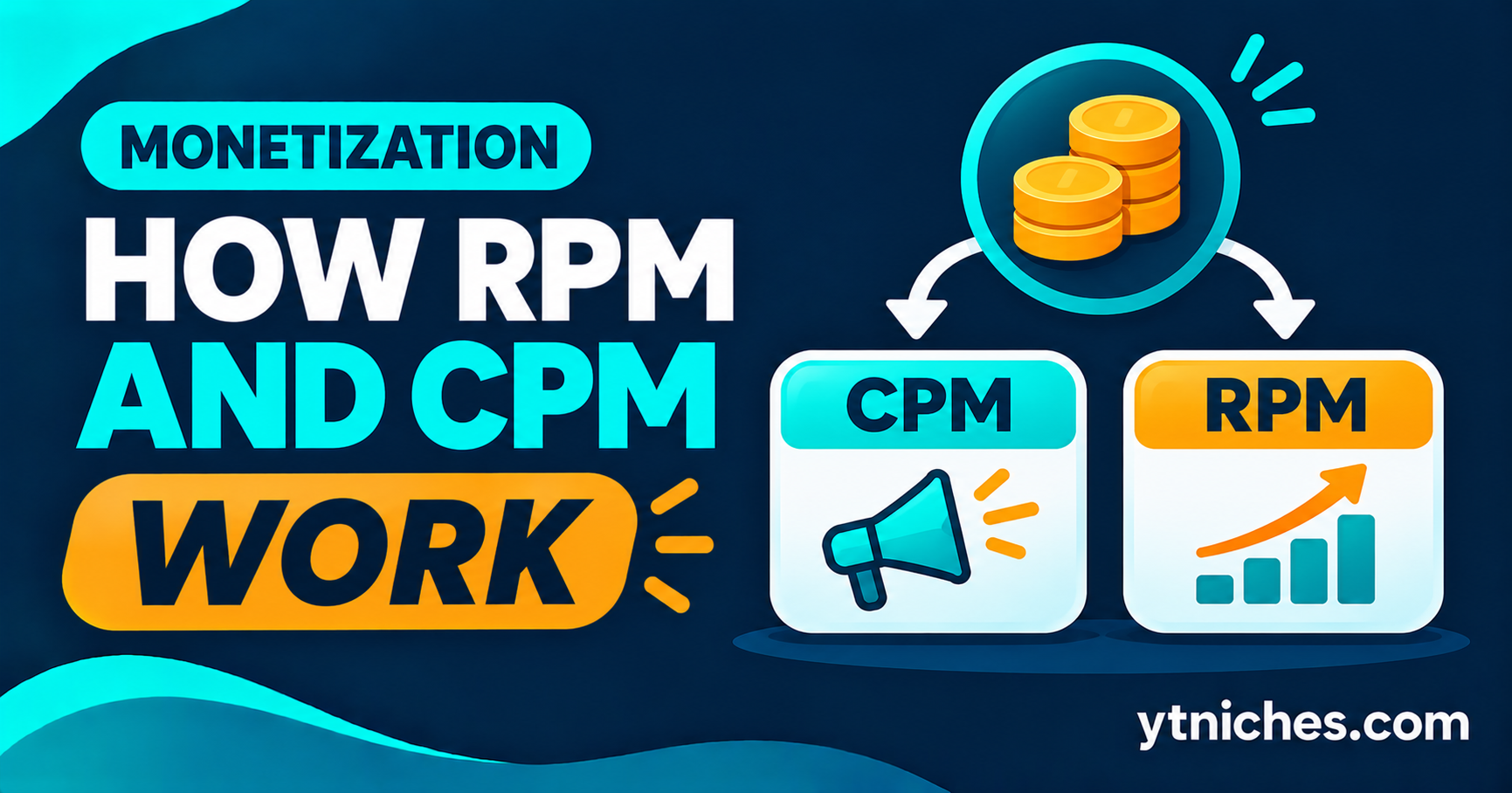
Before analyzing niche benchmarks, it is essential to understand the difference between CPM and RPM:
- CPM (Cost Per Mille): The price advertisers pay to YouTube for every 1,000 ad impressions. This is an advertiser metric. YouTube keeps a 45% platform cut of long-form ad spend, meaning CPM never represents what hits your bank account.
- RPM (Revenue Per Mille): The net money you actually receive for every 1,000 total video views. RPM accounts for YouTube’s 45% cut, ad-blockers, non-monetized views, and YouTube Premium revenue sharing.
$$\text{RPM} = \left(\frac{\text{Total Estimated Revenue}}{\text{Total Video Views}}\right) \times 1,000$$
If your video receives 100,000 views and you earn $850 net, your RPM is $8.50. When planning a channel, RPM is the only revenue figure that matters.
The 2026 YouTube RPM Benchmark Hierarchy
Here is how major content categories typically rank in 2026 (estimated ranges):
| Niche Cluster | Typical RPM Range | Median Benchmark RPM | Primary Advertisers |
|---|---|---|---|
| B2B SaaS, Cloud & Dev Tools | $22.00 – $42.00 | $28.50 | AWS, Snowflake, Datadog, Stripe |
| Personal Finance & Wealth | $16.00 – $32.00 | $21.50 | Trading platforms, credit cards, banks |
| Real Estate & Property Investing | $14.00 – $28.00 | $18.00 | Mortgage brokers, real estate tech |
| Tech, AI & Productivity Tools | $11.00 – $22.00 | $14.50 | Notion, Anthropic, hardware, VPNs |
| Legal, Insurance & Compliance | $12.00 – $26.00 | $16.00 | LegalTech, life insurance, business services |
| Health, Biohacking & Longevity | $8.00 – $17.00 | $11.50 | Supplements, fitness tech, telemedicine |
| True Crime & Forensic History | $7.00 – $15.00 | $9.50 | Audiobooks, VPNs, meal kits, streaming |
| Military Logistics & History Docs | $7.00 – $14.50 | $9.00 | Documentary platforms, male grooming |
| DIY, Woodworking & Restoration | $6.50 – $13.00 | $8.20 | Power tools, home improvement retailers |
| Self-Improvement & Philosophy | $5.00 – $10.50 | $7.00 | Educational apps, book summaries |
| Video Games & Let's Plays | $1.80 – $4.50 | $2.60 | Mobile games, energy drinks, gaming chairs |
| Viral Memes & Reaction Vlogs | $0.80 – $2.50 | $1.40 | Broad consumer goods, apparel |
Estimates, not guarantees. Ranges vary by country, season and audience. See our Earnings Disclaimer.
The 4 Fundamental Drivers of High RPM
Why does a video about tax optimization command about 8 times more advertiser money than a video showcasing a Minecraft speedrun? YouTube's ad auction operates on four fundamental economic drivers:
1. High-Intent Commercial Value (The Customer Lifetime Value Factor)
Advertisers do not bid based on how much they like a creator; they bid based on Customer Lifetime Value (LTV).
- A bank acquiring a new credit card applicant or mortgage borrower can generate $2,000 to $10,000+ in gross profit over that customer's lifetime. Therefore, spending $30 to $50 on YouTube ads to win a high-intent viewer is highly profitable.
- In contrast, a mobile game developer selling $0.99 in-app skin bundles cannot justify bidding more than a few pennies per viewer.
2. Geographic Arbitrage (Audience Location)
Advertiser budgets vary drastically by country purchasing power:
- Tier 1 Countries (United States, United Kingdom, Canada, Australia, Switzerland, Germany) deliver the highest CPMs globally.
- Tier 2 & 3 Countries (India, Philippines, Brazil, Pakistan, Nigeria) deliver massive view volumes but operate at CPMs that are frequently far lower.
A channel based in South Asia producing scripts targeting American financial laws or UK housing markets captures Tier 1 RPMs regardless of where the creator physically resides.
3. Viewer Age & Purchasing Power
Demographics dictate ad spend:
- Audiences aged 28 to 55 have credit cards, disposable income, homes, and investment portfolios. Advertisers aggressively compete for their attention.
- Audiences under 18 have virtually zero independent purchasing power. Content targeting younger demographics inherently suffers from depressed ad rates.
4. Video Duration & Mid-Roll Ad Frequency
Since YouTube lowered the threshold for mid-roll ads to videos longer than 8 minutes, duration has become a massive revenue multiplier:
- A 4-minute video can only display one pre-roll and one post-roll ad.
- An 11-minute video with natural pacing can comfortably support 2 to 3 mid-roll ads without harming retention.
- Multiple ad placements can significantly lift the baseline RPM of an 11-minute documentary compared to a short 3-minute clip in the same category.
Case Study: 50,000 Views Compared
To illustrate the mathematical reality of RPM selection, let us compare two actual small channels tracked in our database over a 30-day window:
Channel A: Casual Gaming Clips
- Format: Gameplay highlights with quick captions
- Subscribers: 42,000
- Target Audience: 16–24, international mix (40% US, 60% Global)
- Average Video Length: 4 minutes 15 seconds
- Monthly Views: 1,200,000
- Observed RPM: $2.10
- Monthly AdSense Payout: $2,520.00
Channel B: Tech, AI & Productivity Tools
- Format: Faceless screen-share tutorials & productivity tool breakdowns
- Subscribers: 19,500
- Target Audience: 25–45, predominantly North America (78% US/CA)
- Average Video Length: 10 minutes 30 seconds
- Monthly Views: 140,000
- Observed RPM: $19.80
- Monthly AdSense Payout: $2,772.00
The Takeaway: Channel B generated more revenue with 88% fewer views. Channel B also required significantly less bandwidth, experienced zero viewer burn-out, and opened the door to $500 software affiliate commissions that Channel A could never dream of securing.
How Faceless & AI Avatar Creators Exploit High-RPM Niches
Historically, high-RPM categories required on-camera authority—you needed a licensed financial planner or seasoned engineer speaking directly to a studio camera.
In 2026, there has been a massive structural shift: many new high-earning channels operate faceless or utilize AI avatar personas.
- Documentary Formats: Creators utilize authoritative narration (via ElevenLabs or professional voiceover artists) paired with historical archives, data visualizations, and kinetic typography.
- AI Avatar Personas: Solo operators design realistic digital personas (such as a grandfatherly historian, a retired corporate investigator, or an analytical researcher) to deliver consistent, humanized delivery without filming logistics.
- Screen-Driven Workflows: In SaaS, repair, and finance niches, showing real spreadsheets, code, or terminal interfaces builds higher trust than a talking head.
How to Calculate Your Channel's Potential Revenue
Before producing your next video, use this simple formula to forecast your earnings:
$$\text{Estimated Monthly Revenue} = \left(\frac{\text{Target Monthly Views}}{1,000}\right) \times \text{Niche Benchmark RPM}$$
For example, if you aim to build a faceless True Crime Documentary channel averaging 250,000 monthly views at an expected $9.50 RPM:
$$\left(\frac{250,000}{1,000}\right) \times $9.50 = \mathbf{$2,375.00 \text{ / month}}$$
Conclusion & Strategic Recommendations
Chasing millions of views in a saturated, low-RPM niche is the fastest route to creator burnout. If your goal is to build an independent, scalable media asset:
- Prioritize Buyer Intent Over Viral Fluff: Target topics where viewers are trying to learn, solve a financial problem, or make a purchasing decision.
- Design for 8+ Minutes: Structure your scripts with strong narrative pacing to unlock natural mid-roll placements without frustrating viewers.
- Target High-GDP Audiences: Frame your titles, cultural references, and examples to resonate with viewers in the United States, United Kingdom, and Canada.
- Study Small Channel Proof: Do not copy channels with 5 million subscribers. Look for small creators under 100k subscribers who are already monetizing the specific niche you want to enter.